

Every study you run on a press assumes the shot you get is the shot you set. The check ring, or non-return valve, at the front of the screw is what makes that true. When it seals well, the screw pushes melt forward into the mold. When it leaks, some melt slips back over the screw during injection and pack, and the amount that slips back changes from shot to shot. A check ring repeatability study tells you whether the press is delivering a consistent shot before you trust anything else you measure on it.
What the check ring does
During screw recovery, the check ring opens so melt can flow forward past it and build the shot in front of the screw. During injection, the ring is pushed back against its seat and closes, so the screw acts like a plunger. A worn ring or seat, a cracked ring, or a ring that closes slowly lets melt flow backward. The result is inconsistent part weight, inconsistent cushion, and a process that seems to drift for no clear reason.
Signs that point to a leaking check ring
- Cushion that varies noticeably shot to shot, or that slowly creeps toward zero.
- Part weight that varies more than the rest of the process would explain.
- Screw that keeps moving forward during hold even after the gate should have sealed.
- Recovery time that becomes longer or more erratic.
- Process studies that will not repeat on that press but do repeat on another.
None of these prove the ring is bad on their own. The study gives you numbers to back up the suspicion.
How to run the study
There are several versions of this test in use. A common, practical one:
- Run a stable process. Use the normal setup, or a fill-only setup, and let the press reach thermal stability.
- Collect a run of consecutive shots, for example ten or more, without changing any settings.
- For each shot, record part (or shot) weight and the cushion at the end of hold.
- Calculate the statistics for both weight and cushion: mean, range, standard deviation (σ), and coefficient of variation (%CV = σ ÷ mean × 100).
Some shops also run a static check: hold the screw under pressure with the nozzle blocked off or with the gate frozen, and watch whether the screw keeps creeping forward. That version needs care and should follow your plant’s safety procedures.
How to read the result
The %CV is the key number because it normalizes variation to the size of the shot, so you can compare different parts and presses. A low %CV on weight and cushion means the ring is holding the shot consistently. A higher %CV is a flag to investigate.
Acceptance limits vary by shop and by application. A limit around 0.5 percent CV on weight is a common starting point, but agree on your own limit, document it, and apply it consistently.
When the result fails:
- Look at the trend, not just the summary. A steady drift in cushion suggests something different from random scatter.
- Rule out other causes. Inconsistent material feed, a bridging hopper, wet material, temperature control problems, or a hot runner zone that is cycling can all add variation.
- Re-run after any repair so you have a before-and-after record.
Illustrative example
The numbers below are the IMPD app’s built-in sample data: generated test data, not from any real customer or production job.
Ten consecutive shots, same settings, pass if weight %CV is under 0.5 percent:
| Statistic | Shot weight | Cushion |
|---|---|---|
| Mean | 178.003 g | 0.200 in |
| Range | 0.130 g | 0.007 in |
| σ | 0.0432 g | 0.0023 in |
| %CV | 0.024 % | — |
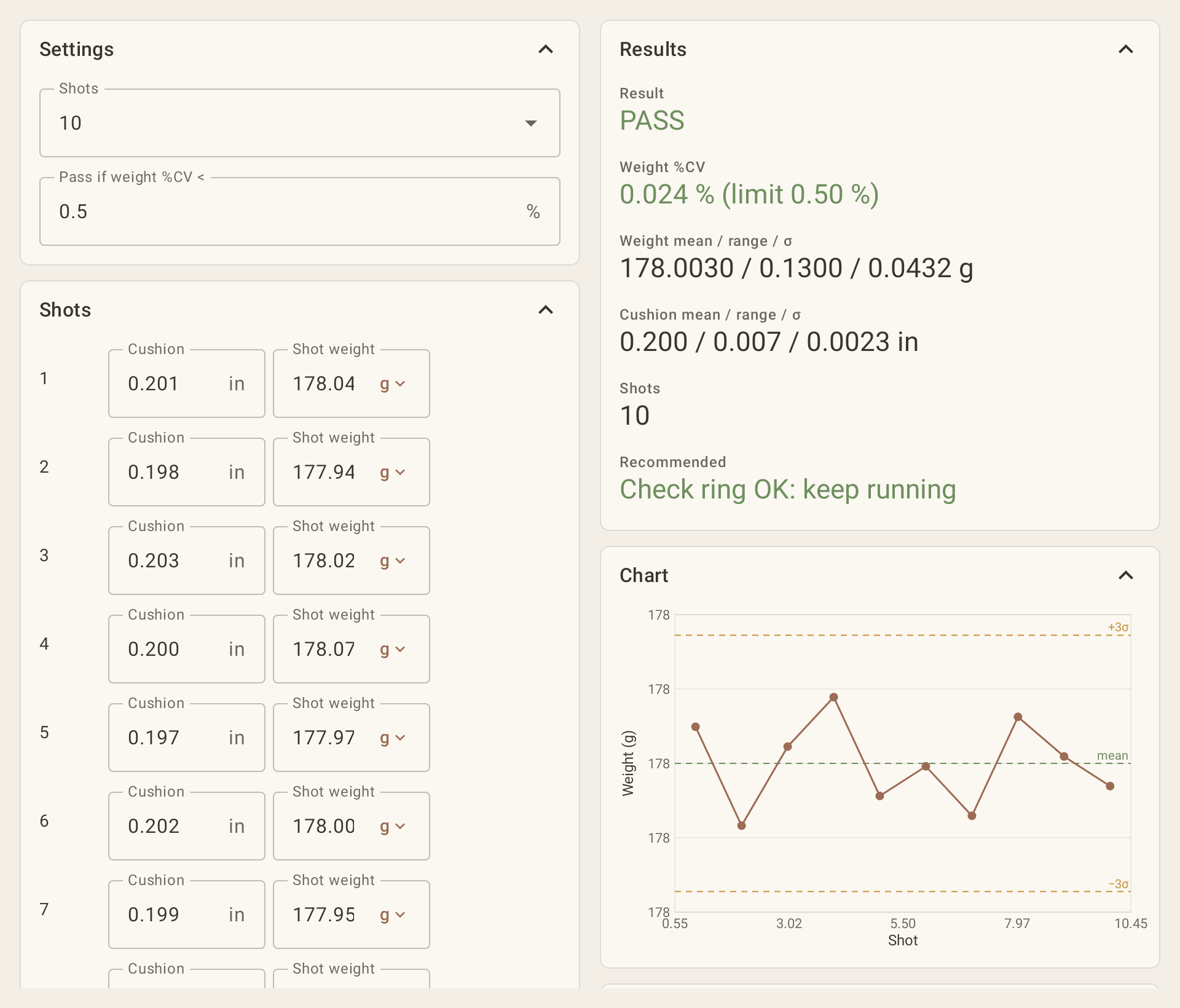
In this sample data, shot weight %CV is 0.024 percent, well inside the 0.5 percent limit, so the study passes and IMPD reports “Check ring OK: keep running.” Cushion varies more in relative terms, which is normal because the cushion is a small number. A processor would still check whether the cushion values trend in one direction or scatter randomly.
Where this fits in process development
Check ring repeatability belongs near the start of a process development effort, alongside a linearity check. If the press cannot repeat its shot, then viscosity curves, gate freeze studies, and cavity balance results on that press will carry that variation with them. Running it early saves you from tuning a process around a hardware problem. It is also useful as a periodic health check, and as a quick test when a proven process starts to drift.
How IMPD supports this
IMPD’s Check Ring Repeatability study calculates the mean, range, σ, and %CV of weight and cushion, with PASS/FAIL against a 0.5 percent CV limit. The results table and chart go into the job’s PDF report alongside any other studies you select. IMPD records data and runs calculations to support engineering decisions; it does not control the machine.
IMPD is coming soon to Google Play. Sign up on the home page to get one email at launch, plus a free month on a yearly subscription.
Leave a Reply